
AI Trading Assistant vs AI Trading Bot: The Difference That Matters
An AI trading bot runs a strategy on its own. An AI trading assistant reads your account and answers questions, but only acts if you explicitly let it. Here is why mixing the two up is risky.
By LTI BLOG Team
AI Trading Assistant vs AI Trading Bot: The Difference That Matters
Two phrases get used almost interchangeably in trading forums, YouTube comments and Telegram groups: "AI trading bot" and "AI trading assistant." They sound like two names for the same thing. They are not. One of them runs a strategy on its own, opening and closing trades without a person confirming each one. The other reads your account, answers your questions, and at most acts inside a scope you explicitly define. Confusing the two is how traders end up assuming a tool understands markets better than it does, or handing over more control than they meant to.
This matters more now that MetaTrader 5 supports MCP (Model Context Protocol), letting an AI assistant such as Claude or ChatGPT connect to a trading account directly. That connection is genuinely useful, and easy to misdescribe. Calling it "AI trading" without qualification puts it in the same mental bucket as a fully automated bot, when the two categories work in close to opposite ways.
- What it does: AI Trading Bot: Executes a strategy that was programmed in advance | AI Trading Assistant: Reads account data, answers questions, surfaces analysis
- Who decides each trade: AI Trading Bot: The program, following rules set ahead of time | AI Trading Assistant: You, based on what the assistant shows you
- Human judgment per trade: AI Trading Bot: None once switched on | AI Trading Assistant: Present unless you have explicitly granted otherwise
- Typical example: AI Trading Bot: An Expert Advisor running a grid or martingale strategy | AI Trading Assistant: Claude or ChatGPT connected to MT5 through MCP
- Where LTI sits: AI Trading Bot: Not positioned as autonomous "AI trading" | AI Trading Assistant: LTI's MCP integration, covered below
Key Takeaways: • An AI trading bot executes a strategy programmed in advance, with no human judgment on any single trade once running. • An AI trading assistant, the category MCP enables, reads your account and answers questions. It only acts with your explicit permission, and only within the scope you set. • "AI trading" and "algorithmic trading" often describe the same mechanism wearing different marketing. Most retail bots branded as AI just follow fixed rules. • Assuming "AI" implies judgment or reliability is the assumption that gets traders into trouble, whichever category a tool falls into. • Both categories carry real trading risk. Neither removes your responsibility for your account, and nothing here is a recommendation to trade.
What Is an AI Trading Bot?
An AI trading bot is a program set up ahead of time with a fixed strategy: entry rules, exit rules, position sizing, and it runs without a person approving each individual trade. The clearest example lives inside MT5 itself: Expert Advisors (EAs), which can run a grid strategy, a martingale strategy, or a breakout rule set continuously, with no one watching each trade fire. Cloud hosted subscription services marketed as "AI trading bots" work the same way under the hood, usually connecting to an account through copy trading or an API key and executing a fixed strategy regardless of the label on the box. The "AI" branding describes the marketing more than the mechanism. Once a bot is switched on, nothing checks each trade against your judgment; it fires by rule until someone turns it off.
That is not automatically a bad design, but it carries a specific risk worth naming plainly: you are trusting a rule set to keep deciding after you have stopped watching, in a market where a losing streak can develop quickly, especially with leveraged forex and CFD positions. Trading in these instruments involves a high degree of risk regardless of whether a human or a program presses the button, and no bot removes that risk.
What Is an AI Trading Assistant?
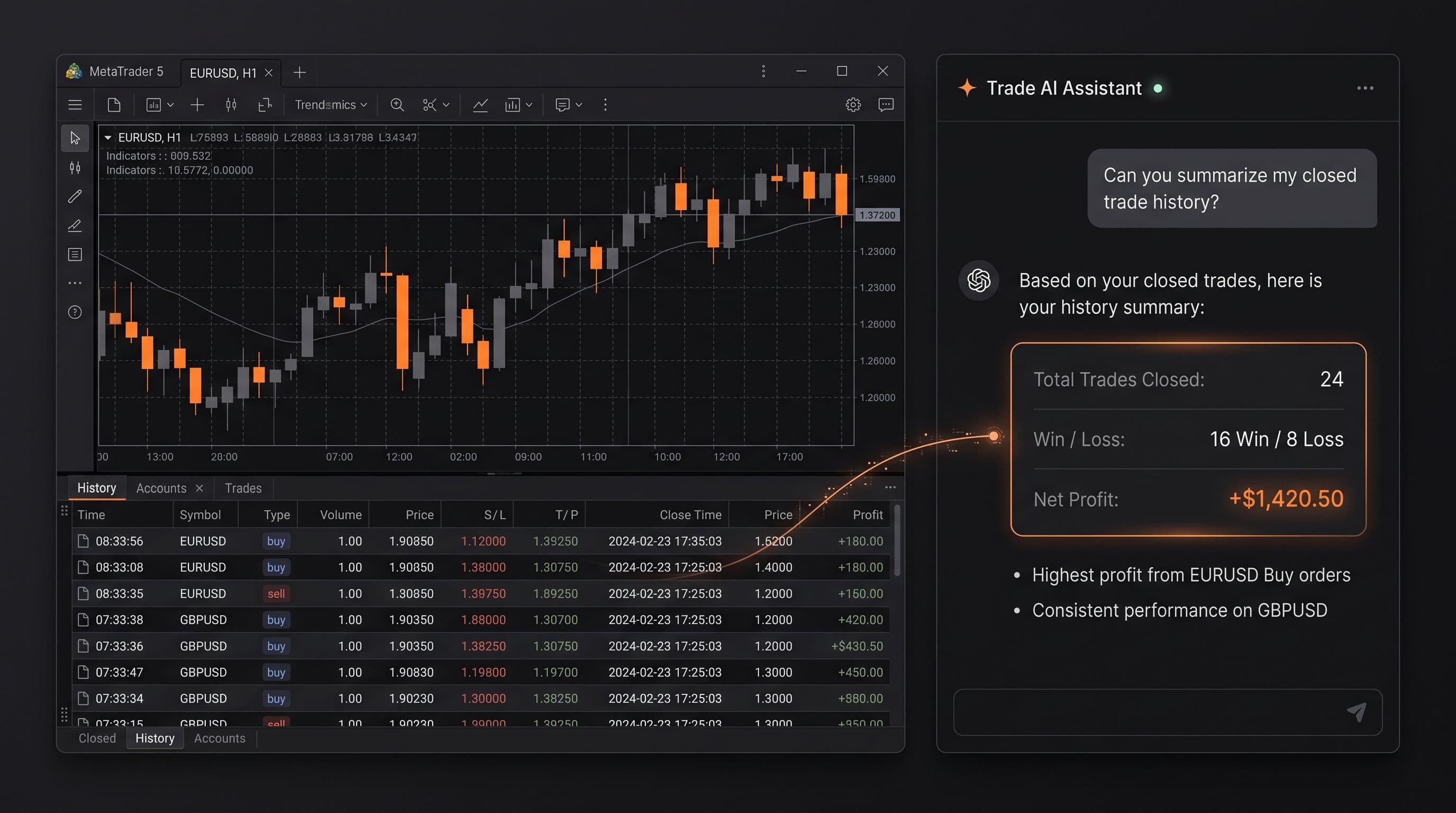
An AI trading assistant is a different category of tool entirely. Through MT5's native MCP support, an assistant such as Claude or ChatGPT can read the account data you have explicitly exposed: open positions, balance, trade history, market prices. It answers questions in plain language, summarizes patterns, and helps you review what has already happened in your account. What it does not do, by default, is act. It waits for you, even while it has read access to everything happening in your account.
A few concrete examples: asking "What is my current exposure to USD pairs right now?" or "Summarize my last twenty trades and tell me if I am cutting winners early." A trader could also say, "If I ask you to close half my position on a specific pair, do it, but touch nothing else without asking me first," and that only works because of a permission set explicitly in advance. Without it, the assistant describes what closing half the position would involve and stops there. The distinction that matters is initiative: a bot decides on its own when to act, by design; an assistant waits on you, no matter how much of your account it can see. For the mechanics of how that connection works, see What Is MCP in Trading? A Plain English Guide.
Why the Line Gets Blurred
Marketing collapses this distinction constantly, because "AI trading" sells better than "a fixed rule program that trades your account unattended." Most of what is marketed today as an AI trading bot is, mechanically, an algorithmic trading system: a defined set of if then rules executing without a person in the loop for any given trade. Calling it AI does not change what it does, only how it is sold. What actually matters is whether a human is making the call on each trade, and whether that human is you.
Underneath the labeling problem sits a psychological trap: the assumption that anything described as artificial intelligence must know what it is doing. A fixed rule bot has no judgment; it follows a rule set that does not update itself when conditions change, unless a person reprograms it. Even a genuinely capable assistant, one that can summarize an entire account history in seconds, has no unsupervised authority over that account unless a person granted it explicitly. The label "AI" implies neither judgment nor authority; both have to be checked directly, tool by tool.
The Assumptions This Confusion Leads To
Conflating bots and assistants produces the same handful of mistakes: assuming a bot is adaptive because it is called AI, when it follows the same fixed rule straight through a losing streak or a volatility spike; assuming that because an assistant can read an account it can therefore also trade that account, and granting it broader permissions than intended, when read access and trading permission are separate settings; and assuming the word "AI" in a product name implies some baseline of testing or reliability, when none of that follows from a label. What a tool actually does, and what access it is asking for, is worth reading directly before connecting anything to a live account.
This is also where a lot of "guaranteed AI returns" offers advertised on social media sit: dressed in AI language, functioning underneath as a fixed strategy committed in advance regardless of what markets do next. LTI's own position is straightforward: no AI tool, whatever it is connected to or however it is marketed, should be treated as a guaranteed forex trader.
Where LTI's MCP Integration Fits
LTI's own MCP integration sits firmly in the assistant category, not the bot category. It reads what a trader has explicitly exposed through MT5's native MCP support and answers questions about that account, or, only where separately granted, carries out an isolated action inside that scope. It does not run a standing strategy, and it does not decide on its own when to open or close a position.
As LTI's own material puts it: "The strongest trading setup is not the one with the most automation; it is the one you can understand, test, monitor, and control." An assistant fits that description; an unattended bot, almost by definition, does not. Wanting that assistant reachable outside desktop hours is a genuine reason to run the terminal on an always available machine, not a reason to let it decide anything unsupervised.
See MetaTrader 5 Now Talks to AI Assistants for the bigger picture, How to Enable Native MCP in MetaTrader 5 for the setup on a demo account first, and Can AI Actually Trade For You? for the fuller question of whether an AI tool can trade for a person at all.
Risk disclosure: Trading in foreign exchange (forex), contracts for difference (CFDs), and other leveraged financial instruments involves a high degree of risk and may not be appropriate for all investors. You should only trade with funds that you can afford to lose without adversely affecting your financial position. No AI tool, including any assistant connected through MCP, is a guaranteed forex trader or capable of trading independently of you.
FAQ
Is LTI's MCP integration an AI trading bot?
No. It reads the account data a trader has explicitly exposed and answers questions, or, only where separately granted that permission, carries out a specific requested action. It does not run a standing strategy or decide on its own when to enter or exit a trade.
Can an AI trading assistant place trades without me asking first?
Only if explicitly configured to, and only within whatever scope was set, such as a single instrument or a maximum order size. Read access and trading permission are separate settings, not one.
Is an AI trading bot the same thing as algorithmic trading?
Mechanically, usually yes. Most products marketed as AI trading bots are algorithmic systems: a fixed set of rules executing without a person confirming each trade. The AI label describes the marketing more than anything adaptive happening underneath.
Does using an AI assistant remove my responsibility for my own trades?
No. Whatever an assistant surfaces or summarizes, the decision and the outcome remain the trader's own, whether the tool is LTI's MCP integration or any other assistant.
Next Steps
The word "AI" alone tells you almost nothing about whether a tool decides for you or waits on you. The question worth asking about any trading tool, AI labeled or not, is simple: who makes the call on each trade, and did you actually agree to that.
See how LTI's assistant works: MetaTrader 5 Now Talks to AI Assistants walks through what a permissioned, read first integration looks like in practice.
*This article is general information about CFDs, leveraged products and instruments, and trading. It is not investment advice, a recommendation, or an offer to trade, and it does not take account of your objectives, financial situation or needs. Refer to the footer for the full disclaimer, terms and policies.
Related Articles
Ask Your Account Anything: 20 Prompts for Reviewing Your Own Trading
20 copy and paste prompts to analyse your trades with AI, covering losses, position sizing, session timing, strategy consistency, and trade management.
Read Article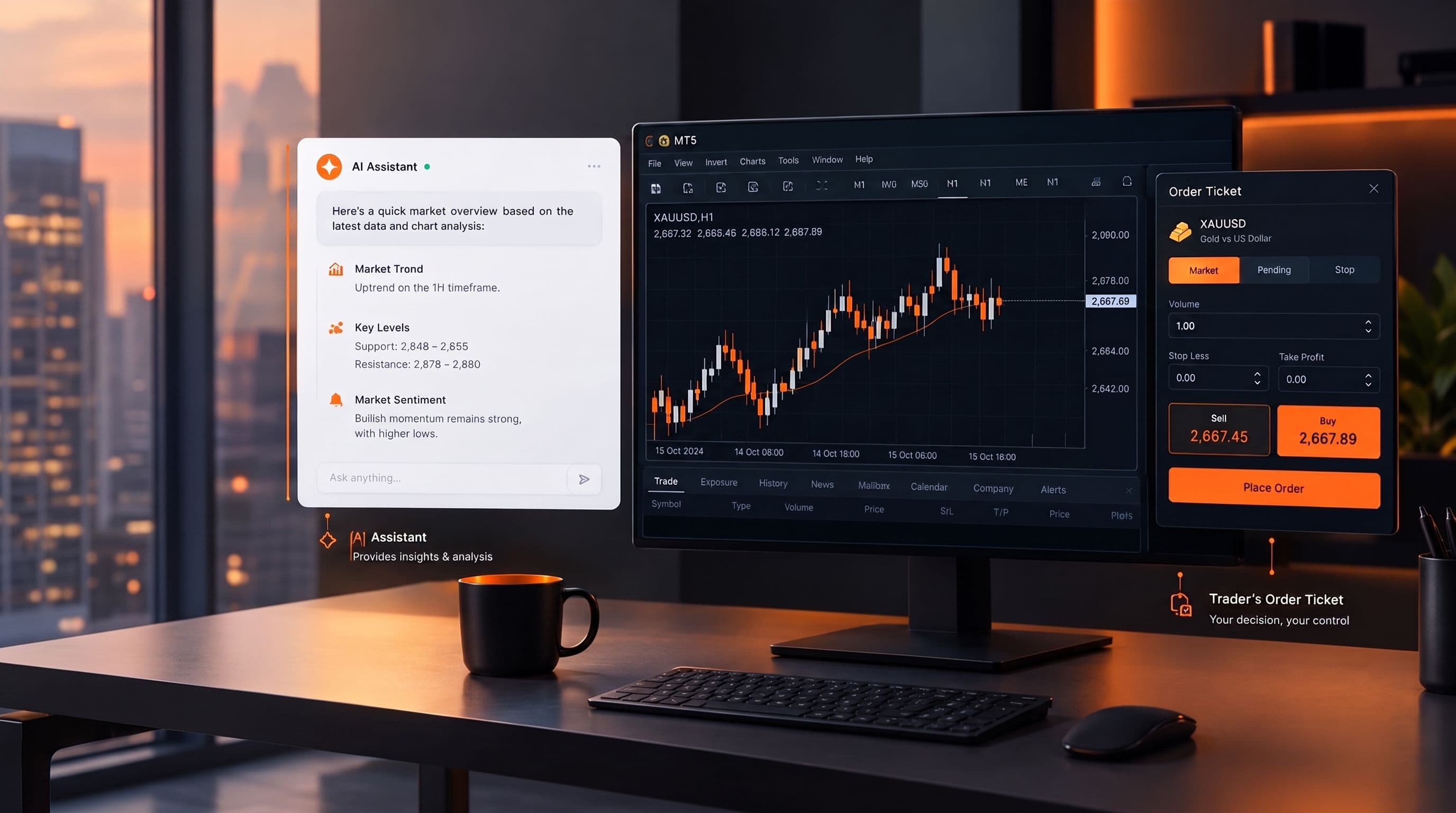
Can AI Actually Trade For You? What MCP Does and Doesn't Do
No, an AI assistant can't trade for you on its own. Here's what it can read, what it needs explicit permission to do, and why the decision stays yours.
Read Article
Is AI Trading Safe? The Risks, the Guardrails and What to Watch
Can an AI assistant withdraw money from your account? No. Here is what MCP access exposes, the real risks like a misconfigured permission, and the guardrails that address each one.
Read ArticleCreate Your Account
Account opening happens in the client area, and takes a couple of minutes.
*Opening an account finishes in the secure client area, where these details carry across. Already registered? Sign in, or talk to us first.
CFDs are complex instruments and come with a high risk of losing money rapidly due to leverage. 73% of retail investor accounts lose money when trading CFDs. You should consider whether you can afford to take the high risk of losing your money.